
Imagine this: you’ve finally made a decision to incorporate solar energy for your business. You are overwhelmed at the thought of saving more on energy bills, boosting sustainability credentials, and may be surprising everyone with your idea at the next board meeting. But then a certain question arises – “How long will this actually take?” It’s not just out of curiosity; it is about planning, executing, and avoiding any mishaps. After all, you cannot ask the warehouse to stop production or a busy office to stop functioning while the solar panels are being installed.
As of early 2025, according to Solar Power Portal, the UK’s total installed solar capacity was around 18–18.1 GW across approximately 1.78 million installations. According to EcoAim, there are over 200,000 commercial and industrial solar panel installations in the UK.
Installing commercial solar panels is not as simple as plugging in a new coffee machine. It’s a process of assessments, permits, equipment delivery, and professional installers climbing over your roof. But here’s the good news: with the right strategy and execution, the process can be smoother than you think. In this guide, we will understand what to expect, how long the procedure is to install, and a few tips that can get your solar panels up and running faster without complications.
The time to install commercial solar panels differs according to the size of the system, building type, and local regulations. Generally, a full commercial solar panel installation takes approximately 2 to 12 weeks from start to finish. Let’s understand the key steps in more detail.
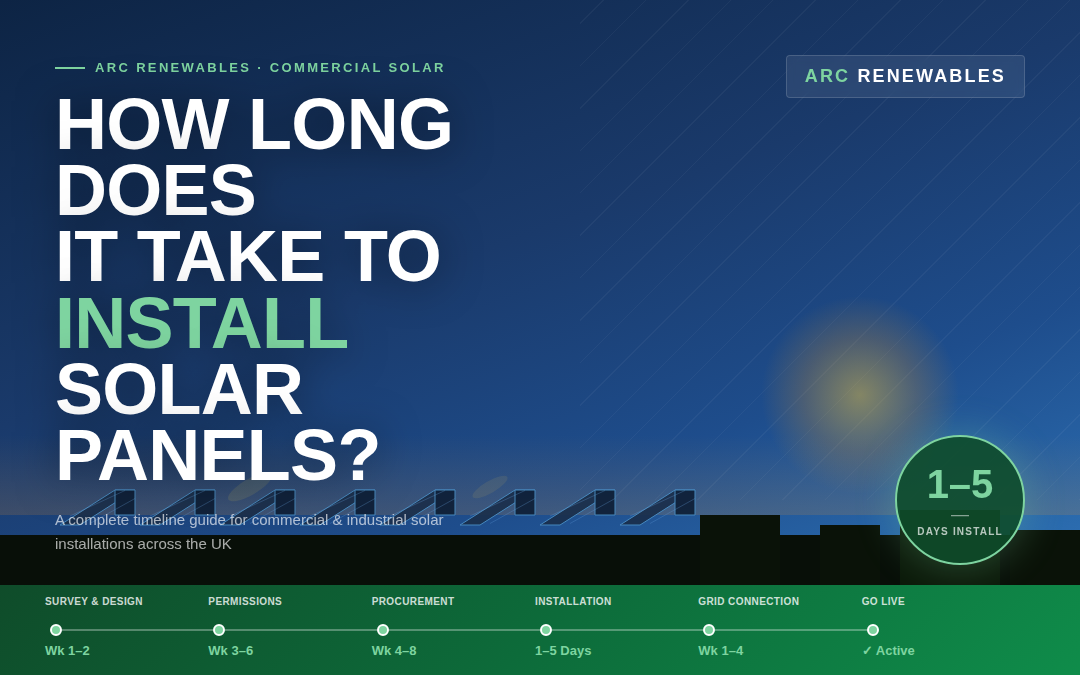
An installer will take a thorough assessment of your commercial property before placing an order for panels. The assessment involves going through roof or ground space, analysing structural integrity, shading issues, and energy requirements. Moreover, the installer will have a look at your current energy consumption to strategise a system that fits your needs perfectly.
Once the installer thoroughly checks the site, the design team will create a customised layout for solar array. This involves panel placement, wiring routes, and inverter positions. For huge complex projects, this stage may include structural calculations and detailed engineering plans for safety purpose and compliance with building regulations.
Getting approvals for planning and electrical work can vary depending on your local council and how complex the system is. Some councils process applications quickly, whereas others might take upto several weeks. Preparing early and providing proper documentation can essentially reduce delays at this stage.
Once the permissions are approved, the required solar panels, inverters, mounting systems, other materials are ordered. Lead times can fluctuate depending on supplier availability especially for larger commercial orders or specialised equipment.
The main process of installation involves mounting panels, connecting wiring, installing inverters, and integrating the system with your building’s electrical setup. A small system setup on the roofs approximately takes under a week, while complicated or large installation may take several weeks.
Once installed, the system must be inspected to ensure compliance with safety standards and building regulations. Following approval, the system is connected to the national grid, tested, and commissioned. Only after this stage can your solar panels begin generating electricity officially. Total Average Duration:
By understanding each phase, businesses can plan operations effectively, avoid unnecessary downtime, and ensure a smooth transition to solar energy.
Before speaking to a professional installer there are a few key points your business can consider to assess the suitability of a commercial solar installation.
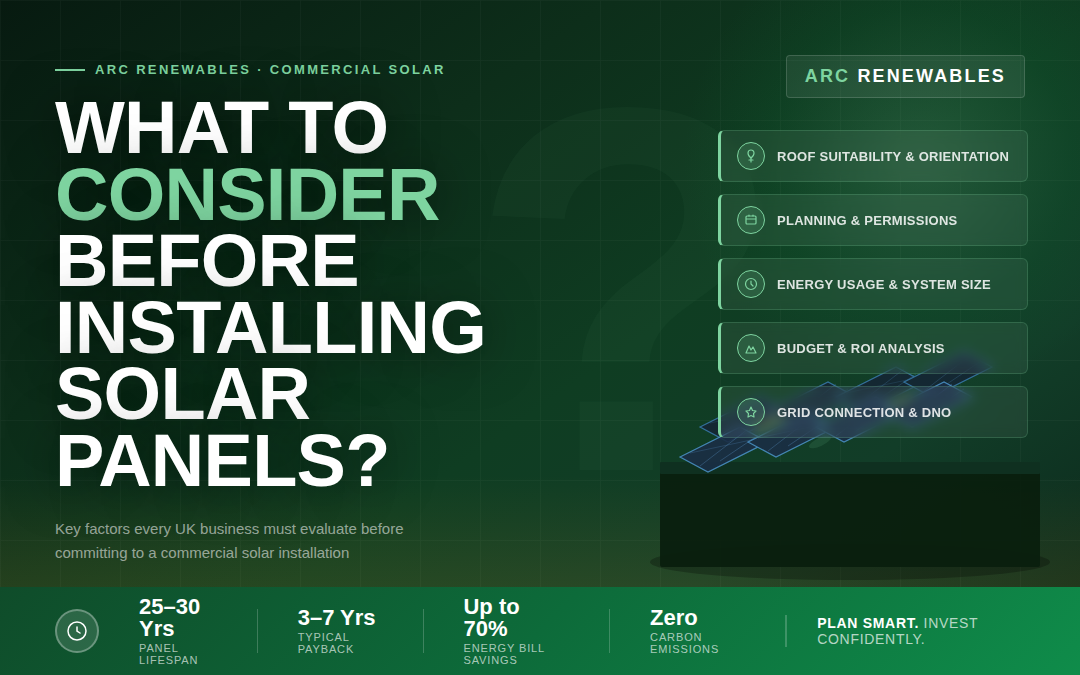
A roof-mounted commercial solar panel installation adds a weight of 10–25 kg/m² for 25+ years so it is essential to ensure your building can safely support this load. Before proceeding with a commercial solar installation it is important to consider the following factors that may make the installation more challenging:
An investment in a commercial solar panel installation is likely to be most effective where:
The initial consultation phase will review the on-site power usage profile of your business to determine the feasibility of on-site solar generation.
Commercial solar panel installations require a significant upfront investment but should produce a positive return on investment over the lifetime of commercial solar equipment. For your business to benefit from this investment it will need to continue occupying the property in the long term.
| Factor | How It Affects Installation Time |
| System size and capacity | Larger systems need more panels, wiring, and labour, thus increasing installation time |
| Roof type and condition | Complex, flat, or ageing roofs may need extra mounting or repairs |
| Structural assessments | Engineering checks and reinforcements can delay the start of work |
| Planning permission | Approval processes may add weeks to the project timeline |
| Grid connection approval | DNO approvals or grid upgrades can cause significant delays |
| Existing electrical infrastructure | Upgrades to switchgear or metering increase installation duration |
| Weather conditions | Poor weather can halt or slow installation for safety reasons |
| Site access and logistics | Limited access or working-hour restrictions slow progress |
| Installer experience | Skilled teams complete installations more efficiently |
| Health and safety requirements | Safety planning and equipment add preparation time |
| Equipment availability | Delays in panel or inverter supply affect schedules |
| Project management | Poor coordination can lead to avoidable delays |
The installation of commercial solar panels is a complex and dynamic process that includes careful planning, detailed design, and precise execution. While the actual installation process of panels takes only a few days but the entire process from planning to final operation can take up to several months. Getting to know each phase and prepare accordingly can help ensure a smooth and successful transition to solar energy, ultimately leading to a long-term savings and sustainability benefits. Worried about choosing the right solar panel installer? The team at Arc Renewables is very professional in installing solar panels. The provide support at each phase of installation and tailor services that cater to your needs. If you planning a new project where you want to install commercial solar panels, Arc Renewables will help you install with expert guidance.
In most cases, commercial solar panels are allowed under Permitted Development Rights and therefore do not require planning permission. However, you may need permission if:
Commercial solar systems are designed to last between 25 and 30 years, with the panels typically covered by a performance warranty of 25 years. Inverters require more frequent replacement, usually lasting between 10 and 15 years.
A standard commercial solar panel requires approximately 2 square metres (21.5 square feet) of space. The number of panels needed depends on the electricity consumption of your commercial property. A single panel will produce, on average, 1.5 to 2 kWh per day in Britain.
Yes, but only with the landlord’s written permission. You may also need to amend your lease to cover:
The full commercial solar installation process typically takes 2 to 4 months from contract to commissioning, broken down into the following stages:
Larger or more complex projects may take longer, particularly if grid upgrades or planning permission are required.
Most of the physical work for a commercial solar installation takes place on the roof, so it is unlikely to disrupt day-to-day operations. A temporary power outage will be required to connect the system to the mains distribution board, but in larger buildings, this is usually isolated to specific areas.